The booking page is the part customers see.This is the part that runs the shop.
You found the small print on a shop's booking page. The live calendar, the vehicle-size pricing, the deposit collected before anyone picked up a phone — none of that is a widget bolted onto a website. It's one screen of the system the shop runs on: bookings, calls, texts, quotes, jobs, invoices, inventory and follow-up in one login, built for PPF, tint, wrap, ceramic and detailing shops.
14-day free trialNo credit cardThe trial runs Command, the top plan
Just booked with a shop? Your appointment is with the shop itself — this page is for the people who run one. How bookings are secured: servicevin.com/security.
Run it back
Every promise on that page was real
The three lines at the top of the shop's booking page aren't slogans — each one is the storefront reporting how it actually works. Here's the mechanism behind each.
“About two minutes”
No account, no sign-up — a customer picks the vehicle, the service and a time, and they're booked. Every field the shop doesn't need is a field that isn't there, which is why it moves like that.
“Real openings only”
The times a customer can pick come from the shop's live calendar — the same board its bays and installers are scheduled on. There's no sync to break, because it's one system, so nobody can book a slot that doesn't exist.
“Priced up front”
Prices come from the shop's own service catalog, sized to the vehicle. It's the same catalog behind their quotes and invoices — which is why the storefront can commit to a number before anyone calls back.
The other side of that page
Every promise up there is a setting in here
The services and vehicle-size prices, the deposit a customer pays to lock a slot, the booking link itself, and the switch that turns the whole storefront on or off — the shop controls all of it from one screen, no developer involved. What you saw over there is this screen, published.
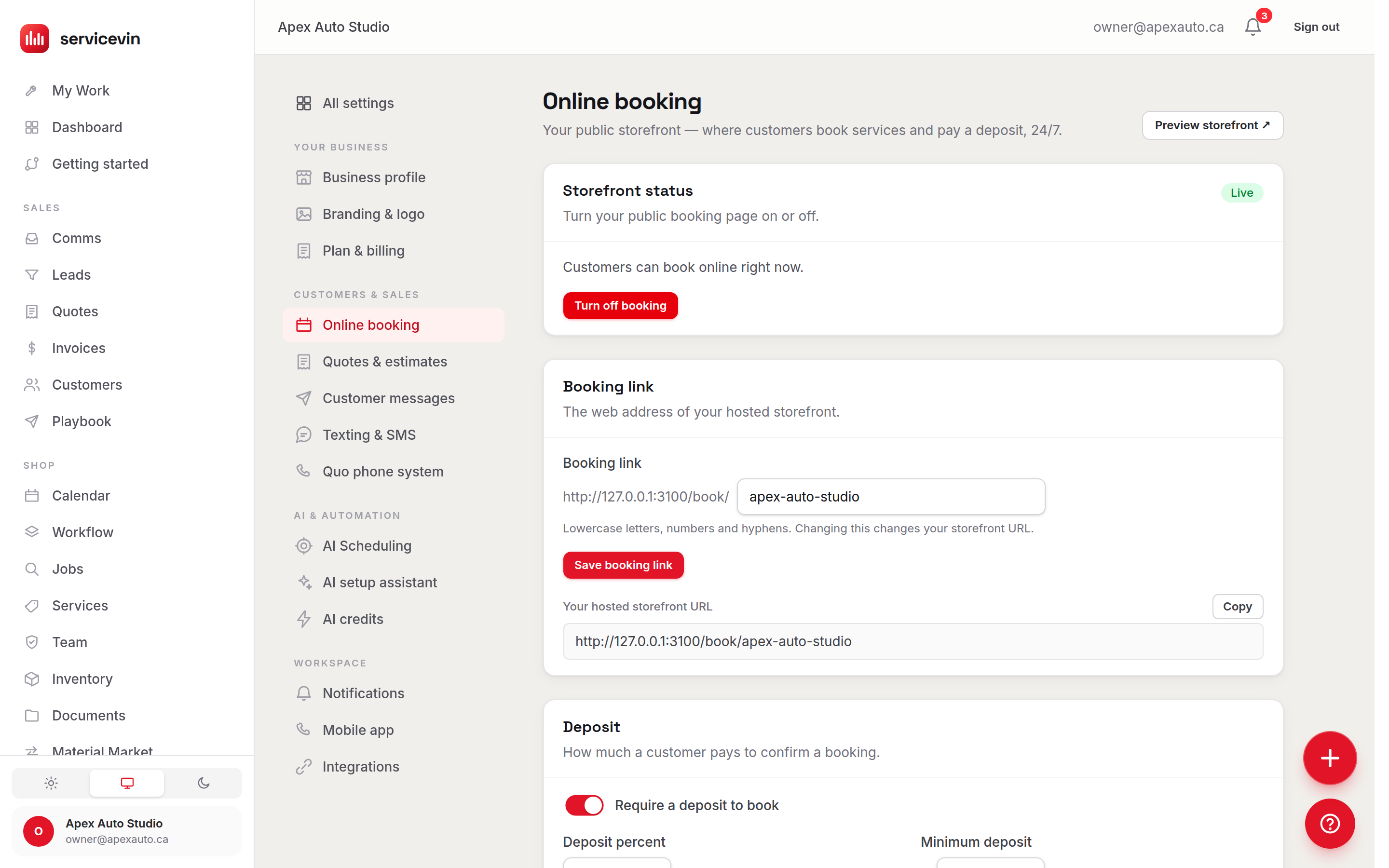
And that's one screen. The other nine tenths of the system is the part your customers never see — and the part that decides whether the week makes money.
The all-in-one part
One login, instead of about six subscriptions
Most shops run the day across a booking widget, an estimating app, a texting tool, a spreadsheet of leads, a calendar that can't see the bays, and a review tool — bills that don't talk to each other. A typical shop consolidating onto Service VIN cancels about six of them. Everything below ships in the same login as the page you just used.
Online booking storefront
The page that sent you here: live openings, vehicle-size pricing, deposits at booking. Every shop gets one at book.servicevin.com/their-name the moment the shop exists — zero setup — or on their own domain with a single CNAME.
No screenshot needed — the booking page that sent you here is this one, live.
Leads & one shared inbox
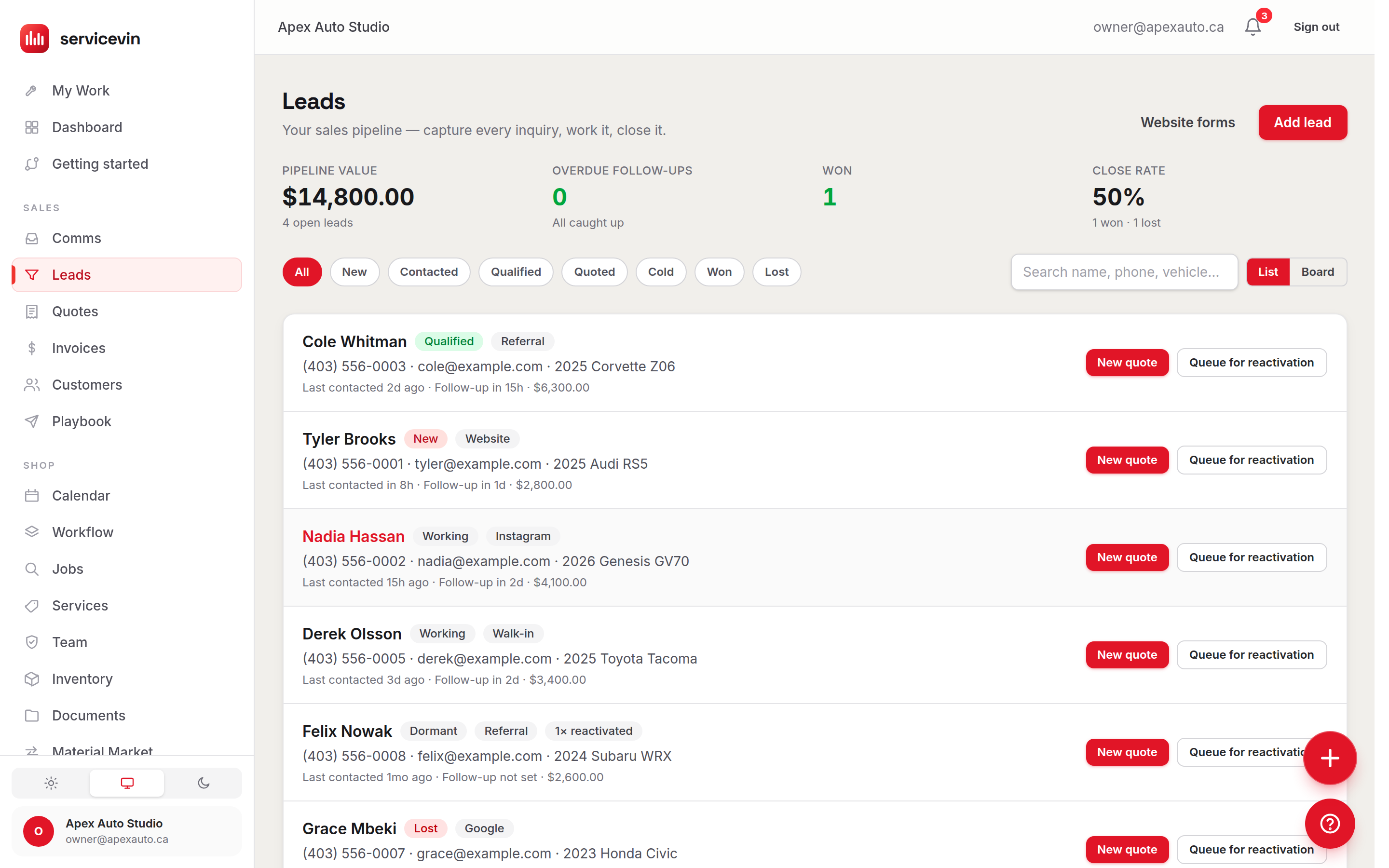
Every call, text and lead-form submission lands in one pipeline, threaded per customer, spam-screened and de-duplicated. Nothing lives — or dies — in a tab only one person has open.
Business phone & texting
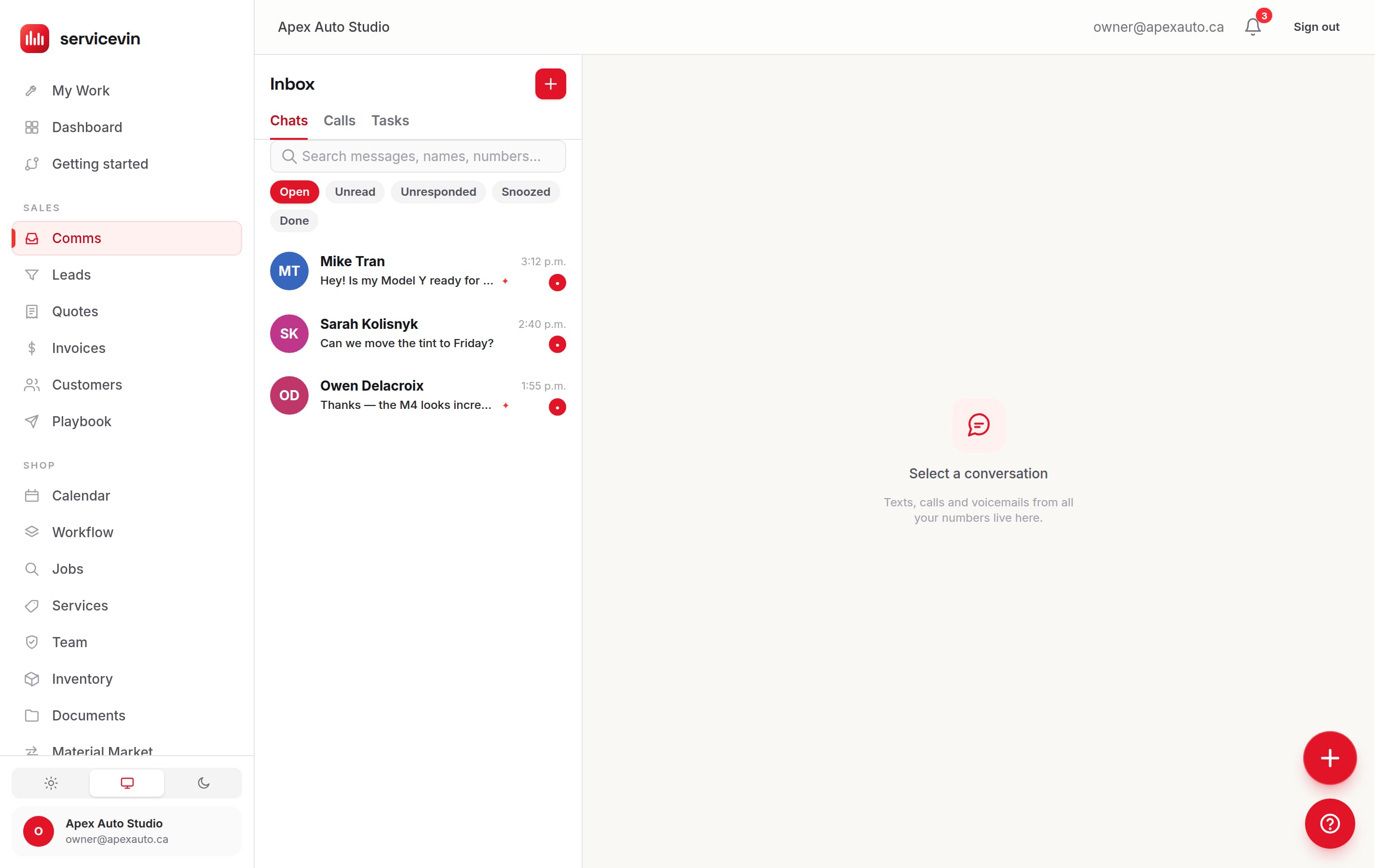
A business number your whole team works: calls recorded, transcribed and summarised, texts sitting beside the customer's quotes and jobs, and a genuinely missed call texted back in seconds — from the shop's number.
Quotes & invoicing
Quotes built from your real catalog with live margin per line, so you see what the job pays before you send it. Approved quotes become jobs, jobs become invoices, and the deposit is already in.
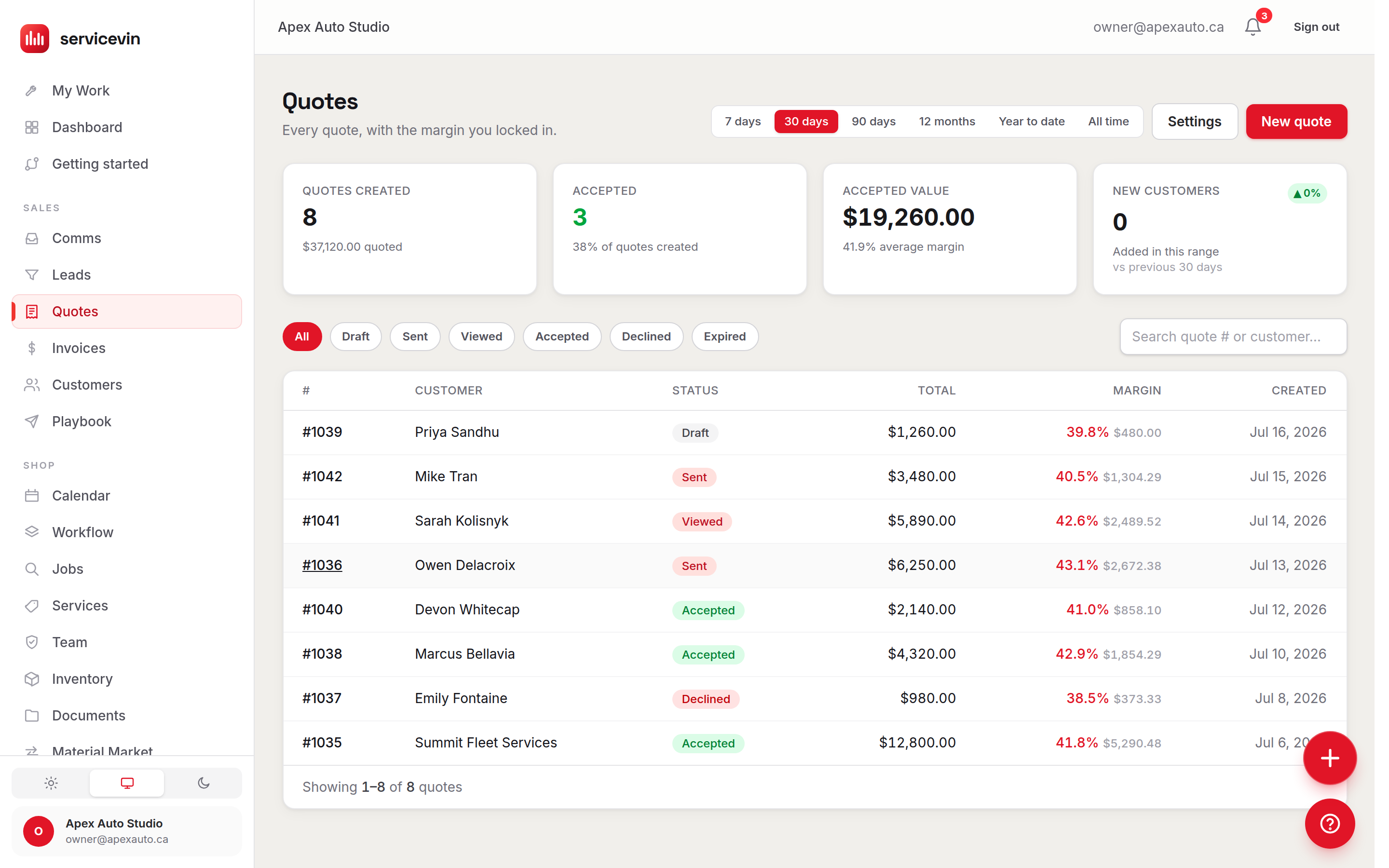
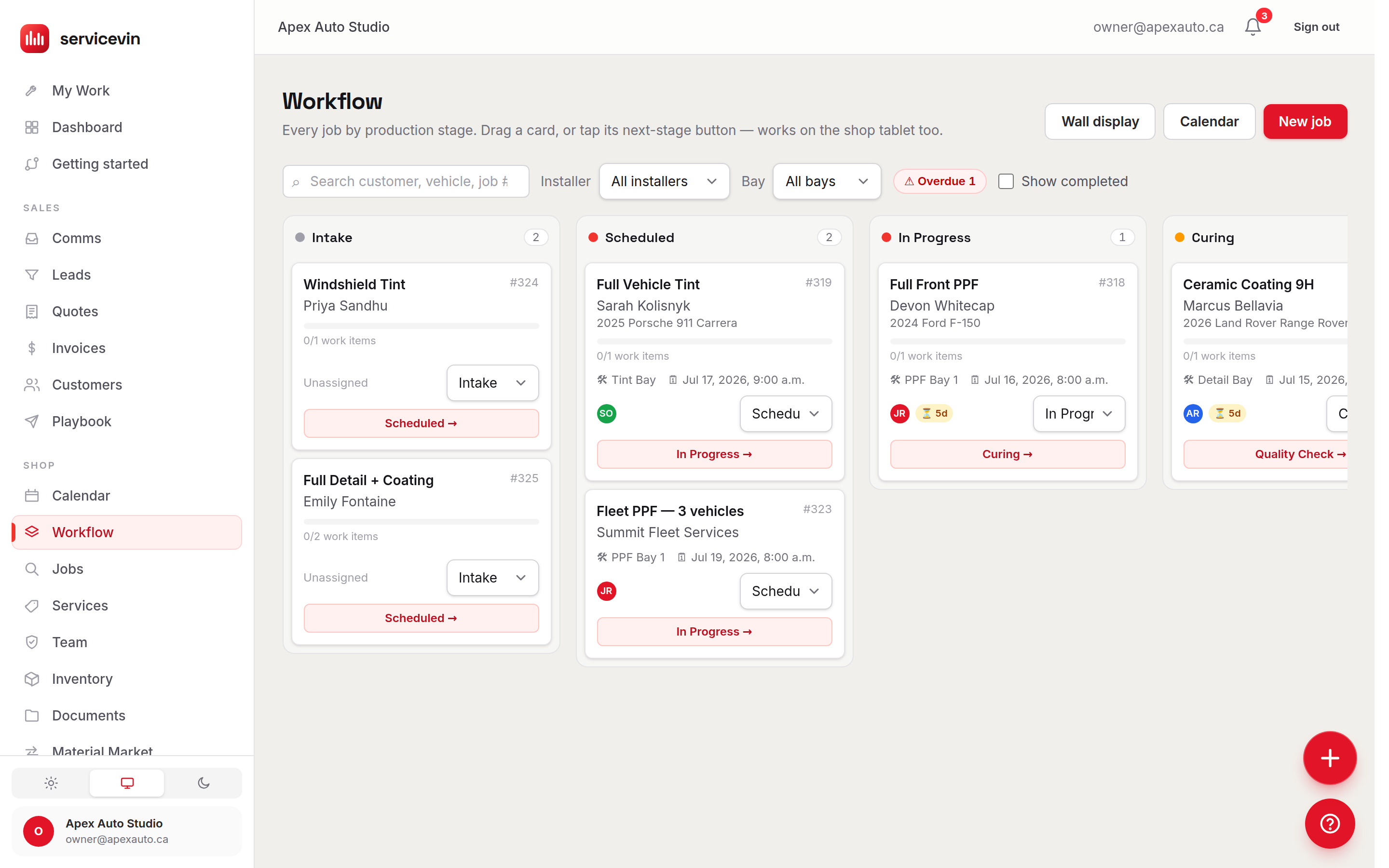
Calendar, bays & the board
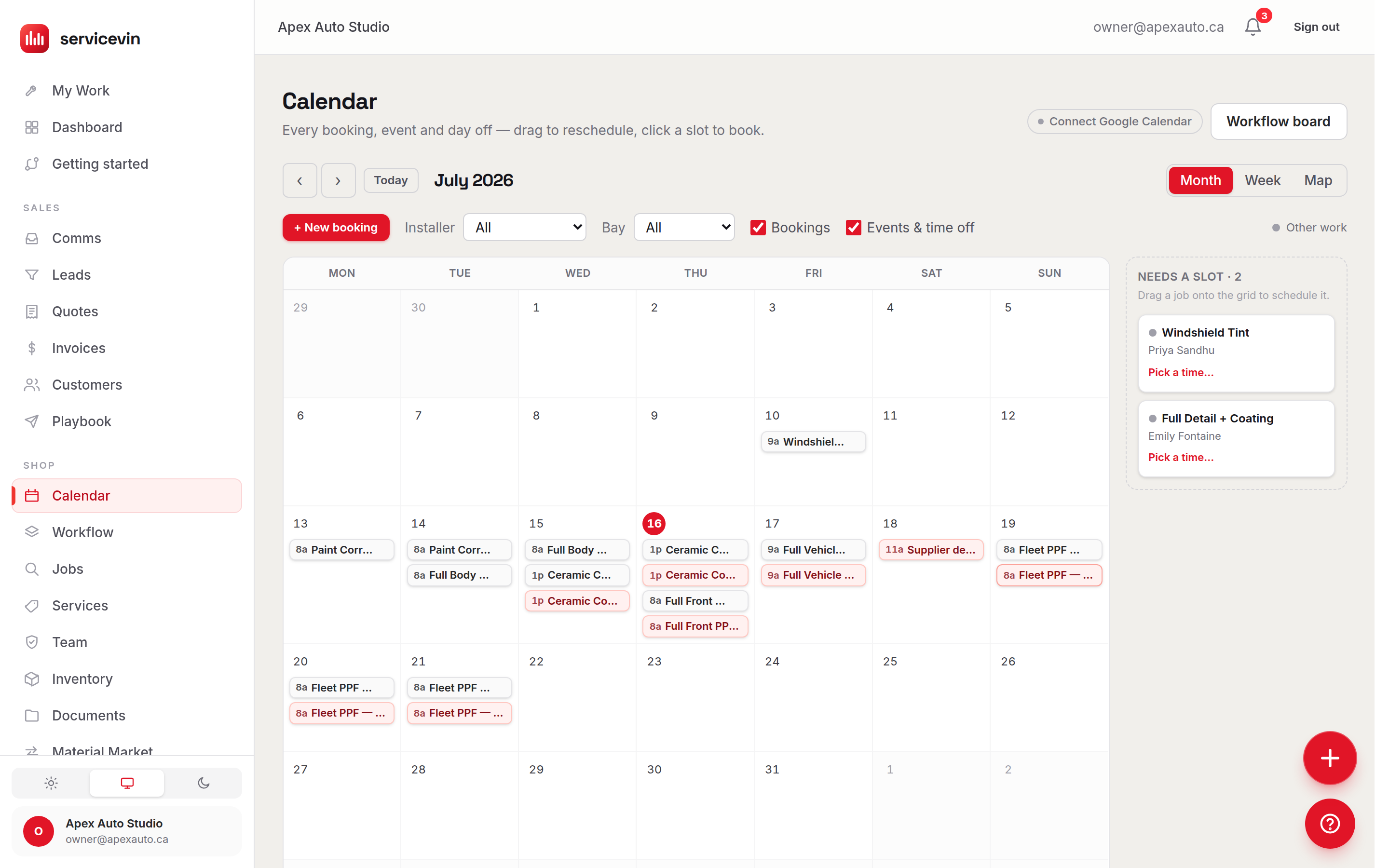
Every bay and every installer on one board, with online bookings landing against real availability. Double-booking stops being a thing that happens to you.
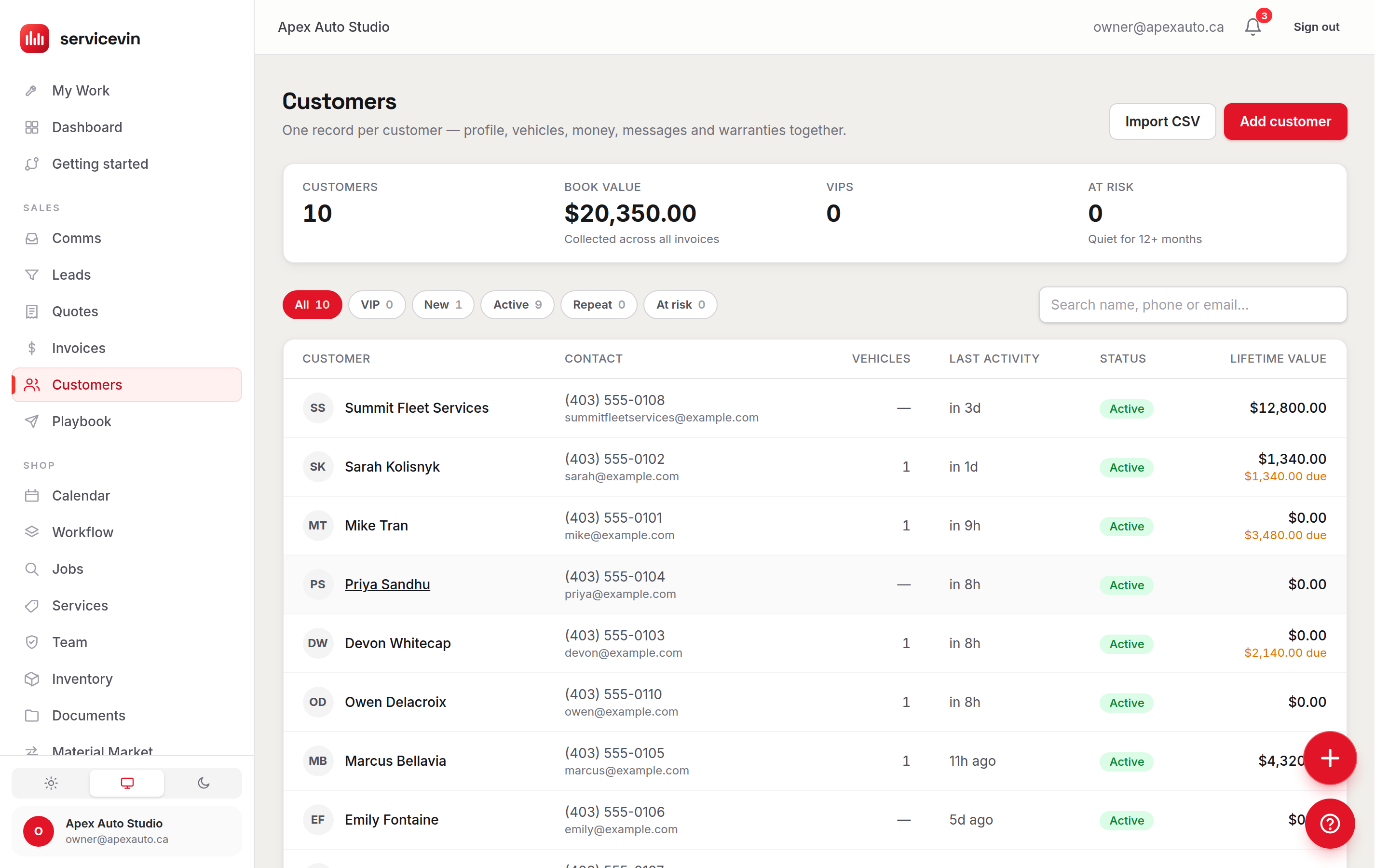
Customers & their garage
One record per customer: their vehicles, their jobs, their conversations, what they've spent. The next quote starts with everything the last one learned.
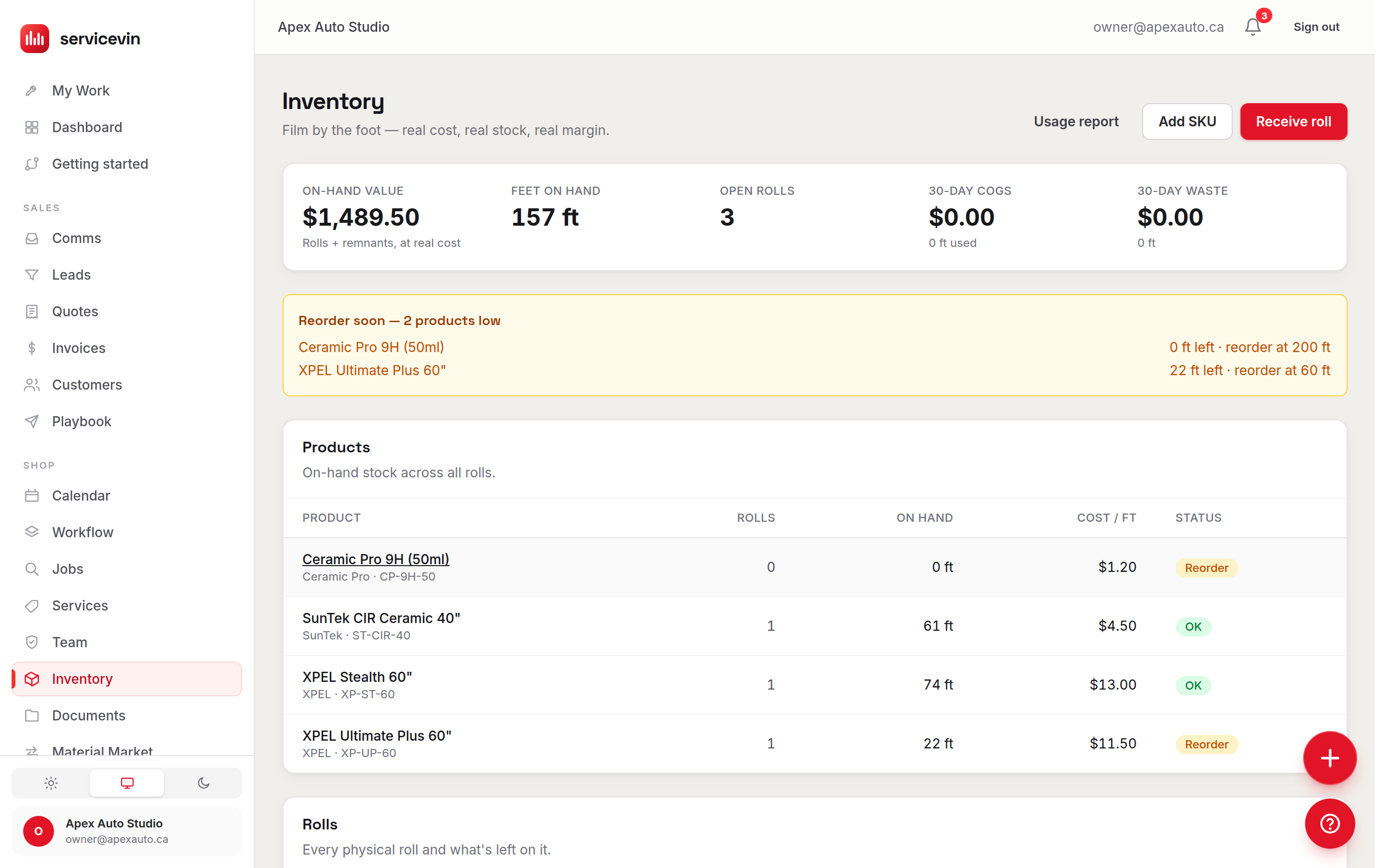
Film tracked to the foot
PPF and tint rolls tracked by the foot and costed into every quote, so the margin on the screen is the margin you actually make when the job's done.
Reviews & follow-up
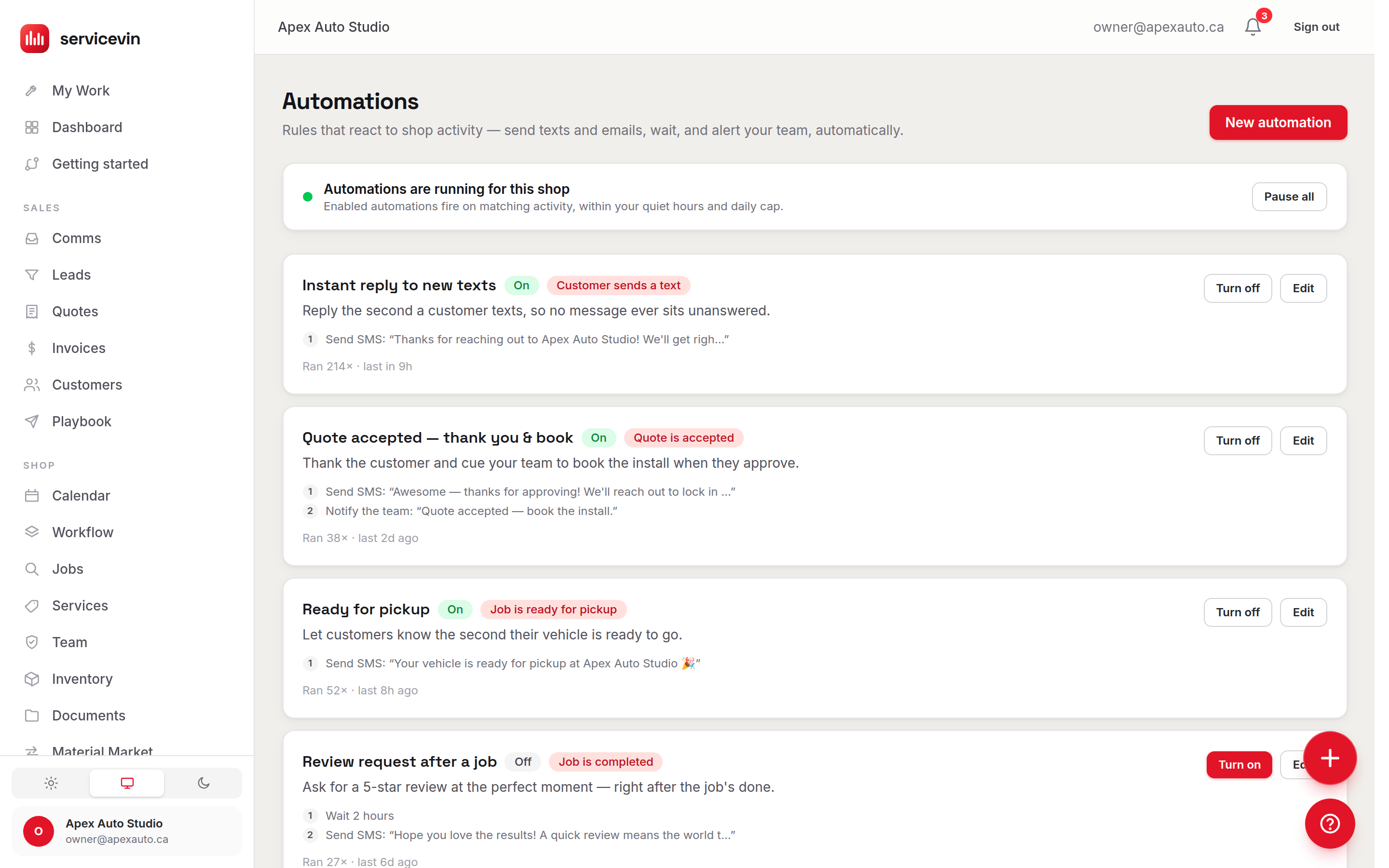
The review request goes out at the moment they're happiest, and the follow-ups nobody has time for — missed-call text-backs, quote chasing, appointment reminders — run on rules you can read and edit.
Marketing measured in invoices
Connect the Google Ads account you already run — read-only — and every campaign is graded in booked jobs and paid invoices instead of clicks, because the same system owns both ends of that trip.
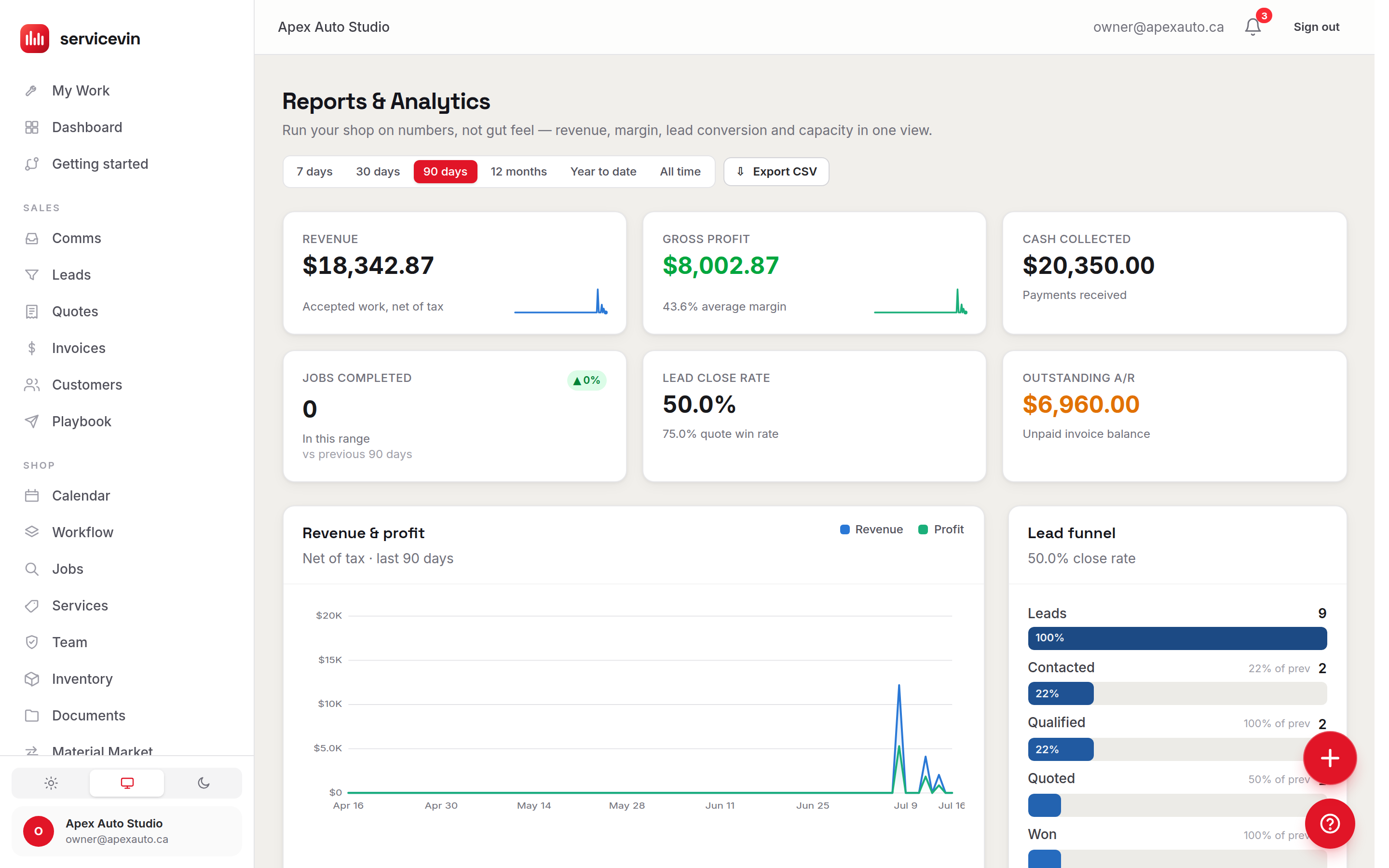
The screens are the real product photographed on a demo shop — sample data, not a customer's account.
Watch it move
One drag, and everything follows
The board, the calendar, the wall display in the bay and the job's own record are one system, so moving a card moves all of them. That storefront you came from writes into this exact board — a 10pm booking is a card here by 10:01.
No per-seat tax — add your whole crew for free — team logins are unlimited from Growth up. The whole tour lives on the features hub.
Built for film & finish
Made for the work you actually do
Generic booking tools treat a car like a haircut. This one was built inside the appearance trades, so the parts that make your work different are the parts it does natively.
Vehicle-size pricing everywhere
A sedan and a Suburban are not the same job. The storefront, the quotes and the catalog all price by size class, so the number a customer sees online is the number you'd have quoted anyway.
Film is a first-class citizen
Rolls, offcuts, cost per foot, and installers scheduled by who can actually do the work. The software speaks PPF, tint and wrap natively instead of translating from “field services”.
Detailing & ceramic, not an afterthought
Packages and add-ons, priced per vehicle size, booked online with a deposit. The same catalog runs a one-bay ceramic studio and a five-bay film shop.
Bays, mobile, or both
In-shop work runs on bays; mobile jobs get dispatch and routing. The calendar knows the difference, so the schedule stays honest either way.
Eleven AI agents — and you approve everything
Calls transcribed and summarised, the quote you promised drafted from your own prices, leads answered with the vehicle already researched — plus automated follow-ups — missed-call text-backs, quote chasing, appointment reminders and review asks. Every agent starts in draft-first mode: nothing reaches a customer until you've read it, and autopilot is a switch you flip once it's earned it. Meet the crew on the agents page.
Proof you can check
No testimonials. Better: the product, running
We don't publish reviews we can't show you the source of, and we won't invent numbers. What we can give you is proof you can verify yourself, right now, without talking to anyone.
You've already watched it work
The booking page that sent you here is the product in production — a real shop, real openings, real prices, real customers. You were in the demo before you knew it was one. The back button replays it.
Poke a live storefront yourself
We keep a storefront running on demo data. Open it, put a fake truck through it, and see exactly what your customers would see — there's no form between you and it.
The founder runs a shop on it
Service VIN is built by Gabriel, who runs a working PPF and detailing shop in Canada — and that shop runs on it every day. When something's clunky, the shop floor finds it before you do.
Recorded, not staged
The margin moves while you type
Every line lands priced off the shop's real film cost and install time, and the margin read-out updates on each keystroke — so a thin job announces itself before the quote goes out, not when the month gets reconciled. This is the screen your estimating app can't become.
Already on something?
Switching is a CSV, not a project
Export from whatever you run today — Urable, Tint Wiz, OrbisX, Jobber, Housecall Pro or a spreadsheet — and our team maps it, dry-runs it against a preview, and loads it for you. The go-live target is 48 hours from the moment your file lands with us.
Your customers never hear a peep
Importing never texts or emails your customers — no automation fires when records are added. That's enforced in our code and covered by our own tests, not a setting we promise to leave off.
You see the dry run first
Our team maps your export and runs it against a preview before anything is written for real. You review the counts — customers, vehicles, history — and nothing is live until you say so.
24 hours of one-click undo
A batch can be reversed for 24 hours after it runs, pulling out the records it added — as long as you haven't started working them. The first load is genuinely low-risk.
Native import presets: Urable, Tint Wiz, OrbisX, QuickBooks Online and Zoho Books. Everything else — Jobber and Housecall Pro included — comes across as a CSV our team maps for you. What transfers today and what doesn't yet is written out plainly on the switching page, honest ledger and all.
What it costs
Flat plans — and the trial runs the top one
Essentials $79, Growth $199 and Command $399 a month, in US dollars, month to month. No per-seat tax — add your whole crew for free — logins are unlimited from Growth up.
Every new shop starts here
14 days of Command — free, no card
The trial runs the top plan, so you're evaluating the whole platform — storefront, phone, quotes, board, inventory, agents — not a cut-down sampler. Keep your current tool running the entire time; nothing forces a switch-over day.
The smaller yes
Not ready to move your shop? Start with the phone.
The AI Front Desk answers the calls you miss, drafts the quote from your own prices and books the job — no migration at all, for $299/mo.
Every plan, line by line, on the pricing page.
Asked by people who found the badge
Will my booking page look like the one I just came from?
It runs your name, your logo, your accent colour, your services and your vehicle-size prices — the flow is the proven one, the shop on it is entirely yours. It exists at book.servicevin.com/your-shop the moment your shop does, and it can live on your own domain with a single CNAME record. And the part that actually matters when you found this on a competitor's page: shops on Service VIN are fully separate tenants. Your customers, prices, jobs and numbers are never visible to another shop — including the one whose page sent you here.
How fast could my shop be taking bookings?
The storefront address exists the moment your shop does — there's no setup step to earn it. What takes time is your catalog: services, vehicle sizes, prices, availability. The AI setup assistant reads your existing website and drafts most of that for you; you review it, fix what it got wrong, and switch the storefront on. No developer, no theme, nothing to install on your website — though the booking link drops into one just fine.
Is this just an online booking tool?
No — booking is the screen you happened to meet first. The same login runs the business number and texting, the shared inbox and leads pipeline, quotes with live margin, the job board and calendar, invoicing and deposits, film inventory to the foot, review requests and the follow-up automations. A typical shop consolidating onto Service VIN cancels about six separate subscriptions — that's the point of it.
What does it cost?
Three flat shop-OS plans — Essentials $79, Growth $199 and Command $399 a month, billed in US dollars, month to month, cancel from Settings. Essentials includes three team logins; from Growth up they're unlimited, with no per-seat charge. There's also the AI Front Desk at $299 a month if you'd rather start with just the phone side. Every new shop starts with 14 days free on Command — the top plan — no credit card required.
We're already on other software. What does switching actually involve?
Export a CSV from whatever you run today and our team maps and loads it for you — you don't line up columns. Native presets exist for Urable, Tint Wiz, OrbisX, QuickBooks Online and Zoho Books; everything else, Jobber and Housecall Pro included, comes across through the same concierge-run any-CSV path. Being straight about scope: customers, vehicles, invoice history, job history and open leads transfer today — photos, quotes, notes and appointment history don't come across via import yet, so plan to start those fresh. Importing never messages your customers, a first batch can be undone for 24 hours before you've worked it, and you can keep your current tool running while you decide. The go-live target is 48 hours from your file landing with us.
Can it really text customers from my business number?
In Canada, from day one — Canadian carriers don't require 10DLC registration, so a Canadian shop texts from its own number as soon as the number is live. In the United States, outbound texting activates after A2P carrier registration; we file it for you and it typically takes about one to three weeks. Calls, recordings, transcripts and the rest of the platform work in the meantime.
I'm a customer, not a shop — I just booked with someone who uses this.
Then nothing on this page is asking anything of you. Your appointment is with the shop itself — its own prices, calendar and messages; Service VIN is the software the shop runs on. Your booking details go to that shop, not to a marketplace or a broker, and the badge you clicked means the page you booked on was served securely by us on the shop's behalf. The fine print lives at servicevin.com/security and /privacy.
Two minutes was enough to book a car in.
14 days is enough to know for sure. Start free, point the setup assistant at your website, and your own storefront — your services, your prices, your name on it — goes live when you flip it on.
No credit card. Keep your current tool running while you decide — and if you bring your book across, importing never messages your customers.